Welcome to our blog ! Here you will find news and updates about sports, politics, artists, and everything that is trending right now. Enjoy the content and stay up to date with the latest trends! Stay Informed with BoomViral News.

"NASA Advances Toward Future Missions with Early Artemis II Progress Review"
Suraay
4/22/20262 min read
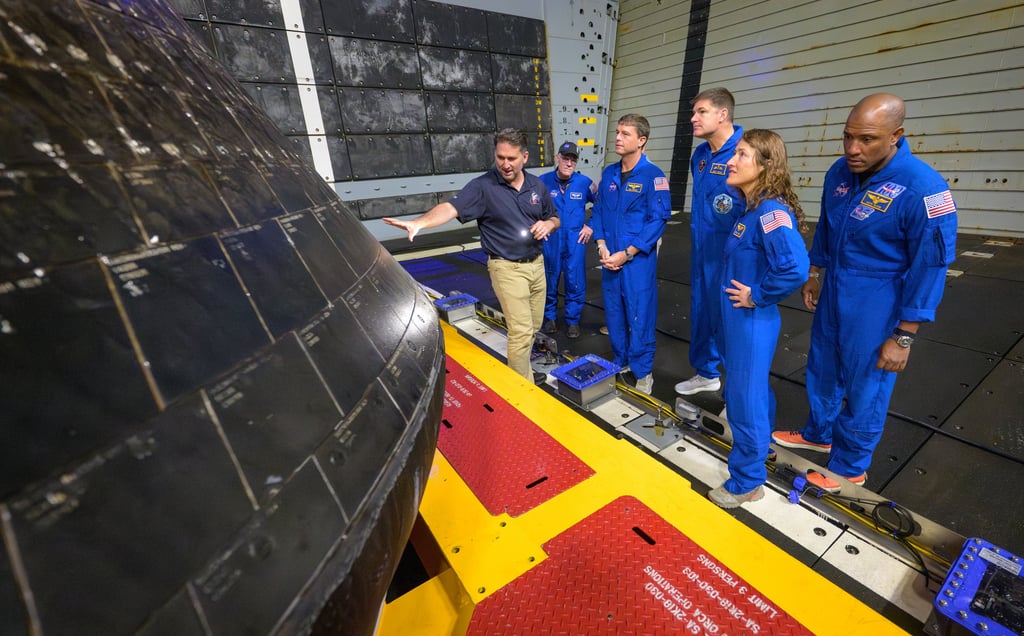
Following the successful splashdown of NASA’s Artemis II mission, engineers have begun an in-depth analysis of data to evaluate the performance of key systems on the Orion spacecraft, the Space Launch System (SLS) rocket, and launch infrastructure at Kennedy Space Center in Florida. The mission marks a major milestone, helping pave the way for Artemis III, future lunar surface missions, a potential Moon base, and eventually human exploration of Mars.
Orion Spacecraft Performance
After traveling approximately 694,000 miles around the Moon and back, the Orion spacecraft safely reentered Earth’s atmosphere and splashed down off the coast of San Diego on April 10. During reentry, the spacecraft endured extreme conditions, traveling nearly 35 times the speed of sound. Its thermal protection system performed as expected, successfully shielding both the crew and the vehicle.
Initial inspections revealed no unusual issues. Notably, damage to the heat shield was significantly reduced compared to Artemis I, aligning closely with pre-flight testing data. Additional imagery captured during reentry will provide further insight into heat shield behavior and performance.
The crew module is scheduled to return to Kennedy Space Center for further examination, including detailed inspections, data retrieval, and removal of reusable components. Later, the heat shield will be transported to Marshall Space Flight Center for deeper analysis, including sample extraction and internal scans.
Other components, including ceramic tiles and thermal materials, also performed as expected. Orion’s landing was highly precise, touching down just 2.9 miles from its intended target.
SLS Rocket أداء
NASA’s SLS rocket successfully met all mission objectives. Early data shows it delivered Orion into the correct trajectory with remarkable accuracy. At engine cutoff, the spacecraft reached speeds exceeding 18,000 miles per hour, achieving its planned orbital insertion.
Ground Systems and Recovery Operations
Post-launch assessments of the launch pad and mobile launcher showed minimal damage, thanks to improvements made after Artemis I. Reinforced structures and upgraded systems allowed critical operations, such as cooling and gas distribution, to continue functioning effectively despite the intense launch conditions.
Following splashdown, recovery teams—including U.S. Navy divers—successfully retrieved the crew and spacecraft. Astronauts were safely transported aboard the USS John P. Murtha, and the Orion capsule was returned for further processing.
Looking Ahead
Using data from this first crewed Artemis mission, NASA is now preparing for Artemis III, currently targeted for 2027. This mission aims to return astronauts to the lunar surface, with broader plans to establish a sustained human presence on the Moon beginning in 2028 and support future missions to Mars.